

March 3, 2026 Total Lunar Eclipse: Your Complete Blood Moon Viewing Guide
What Is the March 3, 2026 Total Lunar Eclipse?
The March 3, 2026 total lunar eclipse is one of the most anticipated astronomical events of the year. During this celestial alignment, Earth passes directly between the Sun and Moon, casting its umbral shadow across the entire lunar surface and producing the deep copper-red glow widely known as a blood moon.
Unlike a solar eclipse, a total lunar eclipse requires no protective eyewear and is visible to anyone under a clear sky within the designated visibility zone. This event delivers a complete totality phase — making it a true blood moon, not a partial or penumbral event.
NASA’s official eclipse portal provides precise contact times, geographic visibility paths, and Saros cycle data for the March 3, 2026 total lunar eclipse — verified directly from the NASA Eclipse Website.
Where Will the March 3, 2026 Blood Moon Be Visible?
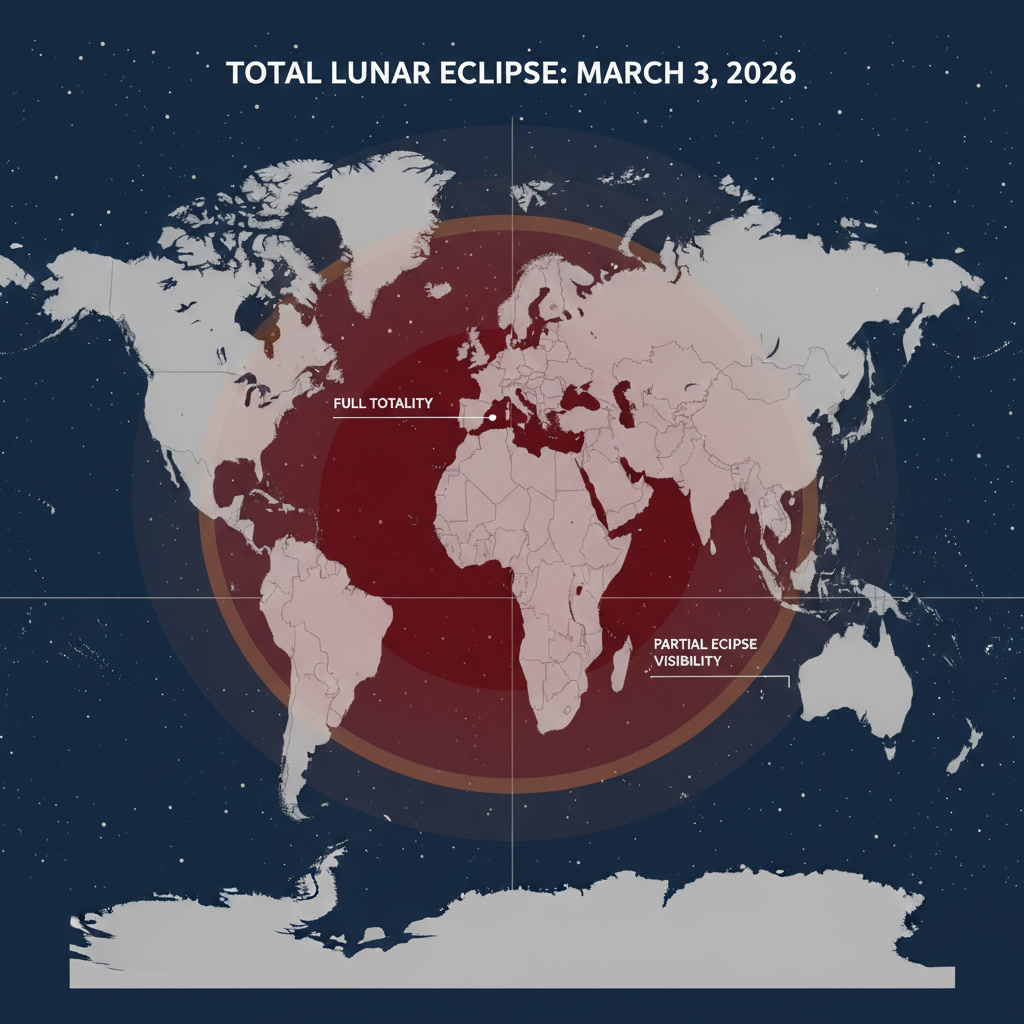
Visibility covers a wide geographic band across two hemispheres:
- Full totality: Eastern Asia, Australia, Pacific Ocean, North America, Central America
- Partial eclipse only: Central Asia, much of South America
- Not visible: Africa and Europe — the Moon falls below the horizon during the event
North American viewers in Central and Eastern time zones experience totality in the pre-dawn hours. Eastern Asia and Australia have favorable evening timing. This broad visibility window makes the March 3 blood moon one of the most accessible total lunar eclipses of the decade for the Pacific Rim.
Blood moons have long been interpreted as powerful windows for spiritual reflection — a theme that runs parallel to the angel number 4 meaning, which carries its own symbolism of grounded transformation, cosmic order, and the completion of cycles. Check out our guide for angel numbers.
What Does a Blood Moon Look Like?
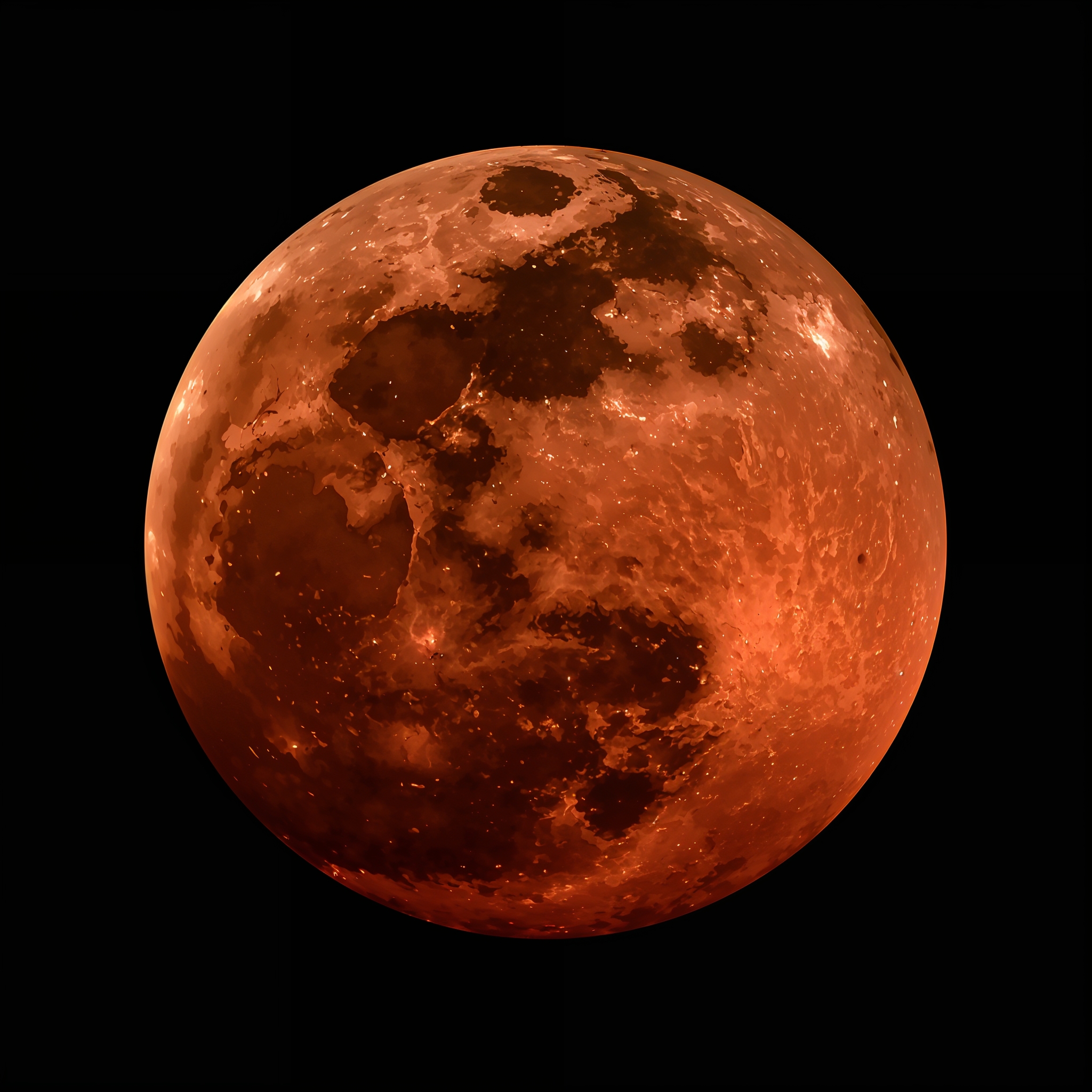
At maximum totality, the Moon displays a deep coppery-red to rusty-orange color. This coloration results from sunlight refracting around Earth’s atmosphere and redirecting onto the lunar surface — the same optical mechanism behind vivid red sunrises and sunsets, known as Rayleigh scattering.
The precise shade of red during totality depends on current atmospheric conditions. High particulate levels from volcanic activity or large-scale wildfire smoke deepen the red significantly. A clean, stable atmosphere produces a brighter orange-amber glow.
The Moon remains fully visible to the naked eye throughout totality, making this an event equally suited to casual sky-watchers and dedicated astrophotographers.
How to Watch the March 3, 2026 Lunar Eclipse
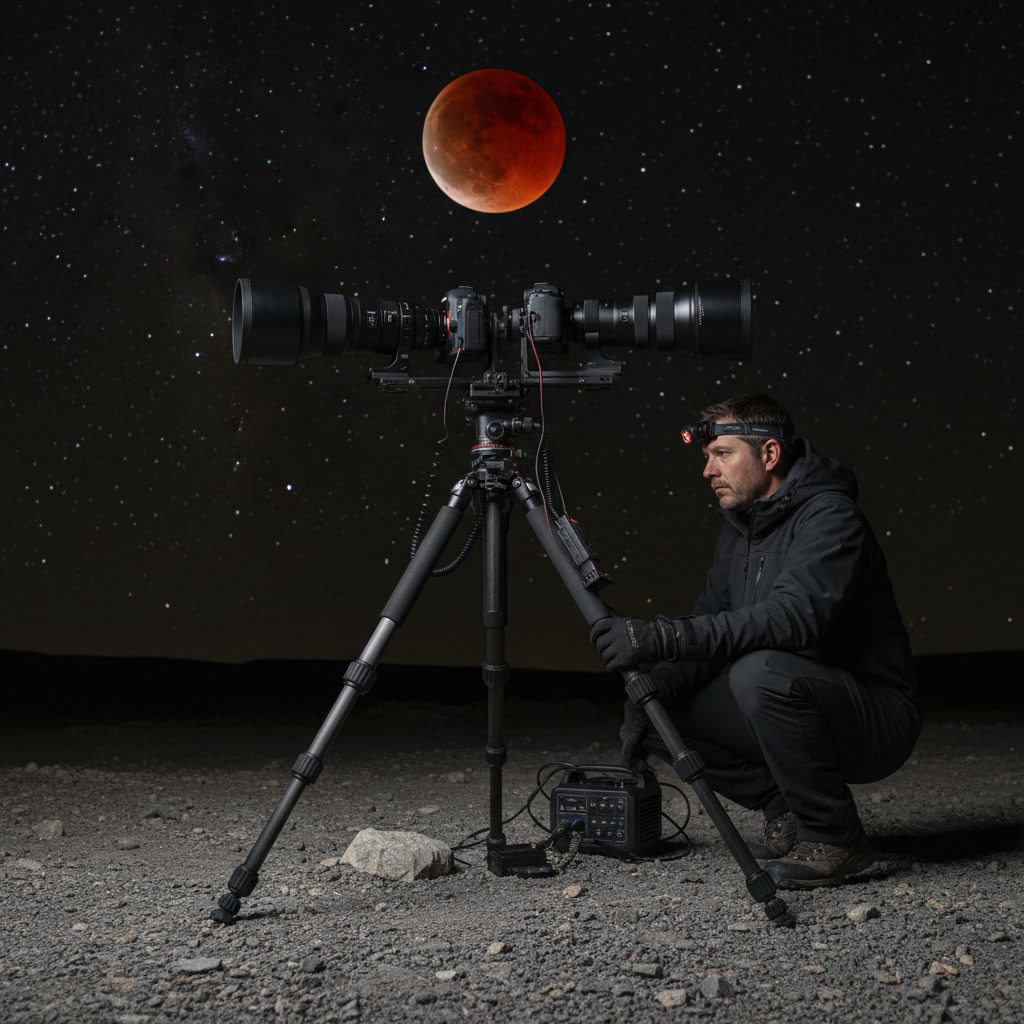
No equipment is required. Total lunar eclipses are completely safe to observe with the naked eye.
Optimal viewing conditions:
- Unobstructed horizon in the Moon’s direction
- Minimal light pollution — parks, elevated terrain, or rural locations outperform urban rooftops
- Clear sky forecast with low humidity
Practical preparation checklist:
- Verify local weather the evening before and morning of the eclipse
- Allow 15–20 minutes for dark adaptation after leaving interior lighting
- Dress in layered clothing for pre-dawn temperatures
- A reclining chair or ground blanket reduces neck strain during extended observation
- 7×50 or 10×50 binoculars reveal lunar surface texture and crater detail during partial phases
Blood Moon Photography: Settings for Every Camera Type
Smartphone Photography
- Activate Night Mode or Pro/Manual Mode
- Stabilize the device on a tripod or firm surface — even minor movement creates blur at lunar distances
- Tap the Moon to lock focus, then slide the exposure compensation downward to prevent overexposure
- During totality, increase ISO to 800–1600 to compensate for the Moon’s dramatically reduced brightness
- Shoot in RAW format if your camera application supports it
DSLR and Mirrorless Camera Photography
- Use a telephoto lens of 300mm minimum — 500mm or longer produces frame-filling lunar images
- Switch to manual focus and verify sharpness using live view zoom at 10× magnification on the lunar limb
- Bright partial phases: ISO 100–400 / shutter 1/125–1/250 sec / aperture f/8
- Totality: ISO 400–1600 / shutter 1–4 seconds / aperture f/5.6–f/8
- Bracket exposures in one-stop increments across each phase
- Capture frames at regular intervals during ingress, totality, and egress to assemble a multi-phase composite
The Science Behind a Total Lunar Eclipse
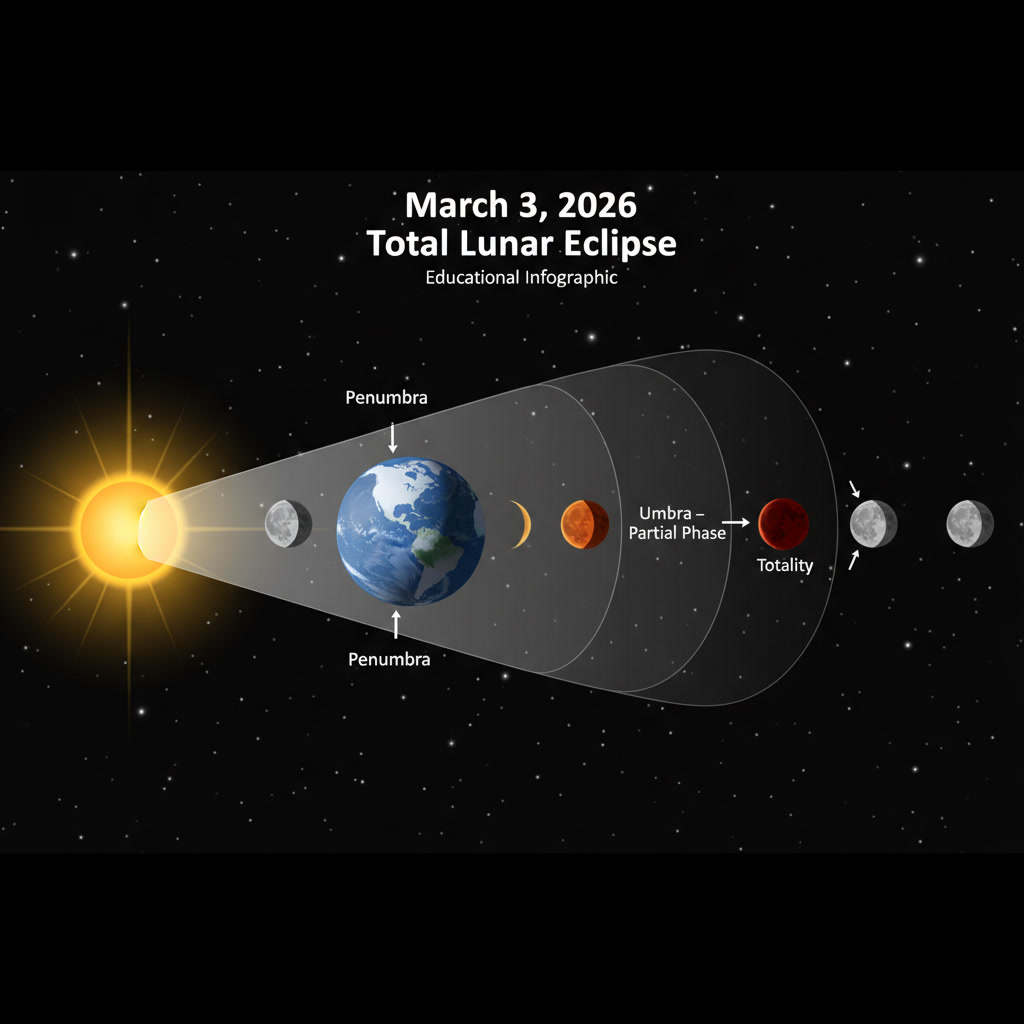
A total lunar eclipse requires three simultaneous conditions: the Moon at full phase, alignment near one of its two orbital nodes, and Earth positioned directly on the Sun-Moon line — a configuration astronomers call syzygy.
The Moon passes through three shadow zones in sequence:
- Penumbra: Earth’s diffuse outer shadow. Subtle dimming occurs, rarely noticeable without comparison photography.
- Umbra (partial phase): Earth’s central dark shadow takes a visibly curved bite from the lunar disk — a direct geometric demonstration of Earth’s spherical shape.
- Umbra (totality): The Moon sits entirely within the umbral shadow. Refracted sunlight from Earth’s atmosphere produces full blood moon coloration across the entire lunar surface.
Total lunar eclipses occur globally two to four times per year, but visibility from any single location is far less frequent. The March 3, 2026 event is a prime opportunity for the Americas and the Pacific Rim.
Spiritual, Cultural, and Historical Significance of Blood Moons
Total lunar eclipses carry documented symbolic weight across human history. Ancient Mesopotamian astronomers catalogued eclipses as royal omens requiring ritual response. Indigenous cultures across the Americas, Oceania, and Asia developed ceremonial practices centered on the blood moon’s appearance. Chinese imperial astronomers used precise eclipse records to calibrate multi-century calendrical systems.
In modern spiritual traditions, blood moons correlate with themes of release, transformation, and karmic completion — the ending of one cycle and the initiation of another.
The March 3, 2026 full moon falls in Virgo, a sign associated in Western astrology with discernment, healing, and the refinement of daily routines. Contemporary lunar cycle communities interpret this placement as a prompt to evaluate health habits, service-oriented work, and the practical systems structuring everyday life.
Upcoming Eclipses After March 3, 2026
The eclipse calendar continues through 2026 and 2027:
- August 2026 — Total Solar Eclipse: Path of totality crosses parts of Europe and North Africa
- 2027 — Lunar Eclipse Season: Additional total and partial lunar eclipse opportunities return for global observers
Bookmark this guide and return for updated timing tables and regional visibility maps as each event approaches.
Set your alarm. Share this guide with anyone who follows the night sky, practices lunar cycle work, or wants to try eclipse photography — and leave your photos or observations in the comments after March 3.
Frequently Asked Questions About the March 3, 2026 Lunar Eclipse
What time is the lunar eclipse on March 3, 2026? The total lunar eclipse begins its partial phase in the early morning hours for North American viewers, with totality lasting approximately 58 minutes. Check the times table above for exact UTC and local conversion.
Is the March 3, 2026 lunar eclipse a blood moon? Yes. The March 3, 2026 lunar eclipse is a full total lunar eclipse, meaning the Moon passes completely into Earth’s umbral shadow and displays the deep copper-red coloration that defines a blood moon.
Where is the March 3, 2026 blood moon visible? Full totality is visible across North America, Central America, the Pacific Ocean, eastern Asia, and Australia. Africa and Europe will not see the eclipse as the Moon sits below their horizon during the event.
Do I need special glasses to watch the lunar eclipse? No. A total lunar eclipse is completely safe to observe with the naked eye. Unlike a solar eclipse, no protective eyewear is required at any phase of the event.
How long does the March 3, 2026 total lunar eclipse last? The complete eclipse event runs approximately 5 hours and 39 minutes from first penumbral contact to last. The blood moon totality phase alone lasts roughly 58 minutes.
Why does the moon turn red during a lunar eclipse? The Moon turns red because sunlight refracts through Earth’s atmosphere and bends onto the lunar surface. Earth’s atmosphere filters out blue wavelengths and allows red and orange wavelengths to pass through — the same process that produces red sunsets.
What is the spiritual meaning of the March 3, 2026 blood moon? The March 3, 2026 full moon falls in Virgo and carries themes of release, healing, and cycle completion. Many lunar cycle practitioners treat blood moons as high-energy windows for reflection, intention-setting, and letting go of what no longer serves growth.
When is the next lunar eclipse after March 3, 2026? The next notable eclipse events occur later in 2026 with a total solar eclipse in August, followed by additional lunar eclipse opportunities returning in 2027.